

Project Details Duration : 03 months Client Website : https://avarynthgroup.com/ Need any service Business Consulting? Feel free
- Duration : 03 months
- Client Website : https://avarynthgroup.com/
Project Overview Malaria remains the leading public health challenge in Katsina State, accounting for approximately 70% of outpatient department (OPD) attendance and showing an increasing trend in diagnosed cases. Malaria elimination activities in the state are coordinated by the State Malaria Elimination Programme (SMEP) within the State Ministry of Health, with implementation and financing support from multiple partners, including the Institute of Human Virology Nigeria (IHVN). IHVN, a leading indigenous non-governmental organization originally focused on HIV/AIDS prevention, care, and treatment, has expanded its mandate to include malaria, tuberculosis, and non-communicable diseases. In July 2015, IHVN was awarded a one-year Global Fund New Funding Model (GF-NFM) malaria grant, supporting malaria elimination activities in Katsina, Jigawa, Kogi, and Benue States. In Katsina State, IHVN-supported malaria interventions aligned with National Malaria Elimination Programme (NMEP) priorities and focused on vector control, community case management, logistics and supply chain management (excluding procurement), monitoring and evaluation, and programme management. Advocacy, communication, and social mobilization (ACSM) interventions were outside IHVN’s scope.
A core priority of the NMEP is the development and periodic review of costed Annual Operational Plans (AOPs) at national, state, and LGA levels. Katsina State had previously developed six malaria AOPs (2011–2016), all of which had undergone at least one standardized review. This project aimed to assess the extent of implementation of the 2016 AOP (January–September) and to develop a state-led, costed 2017 AOP to guide malaria elimination activities.


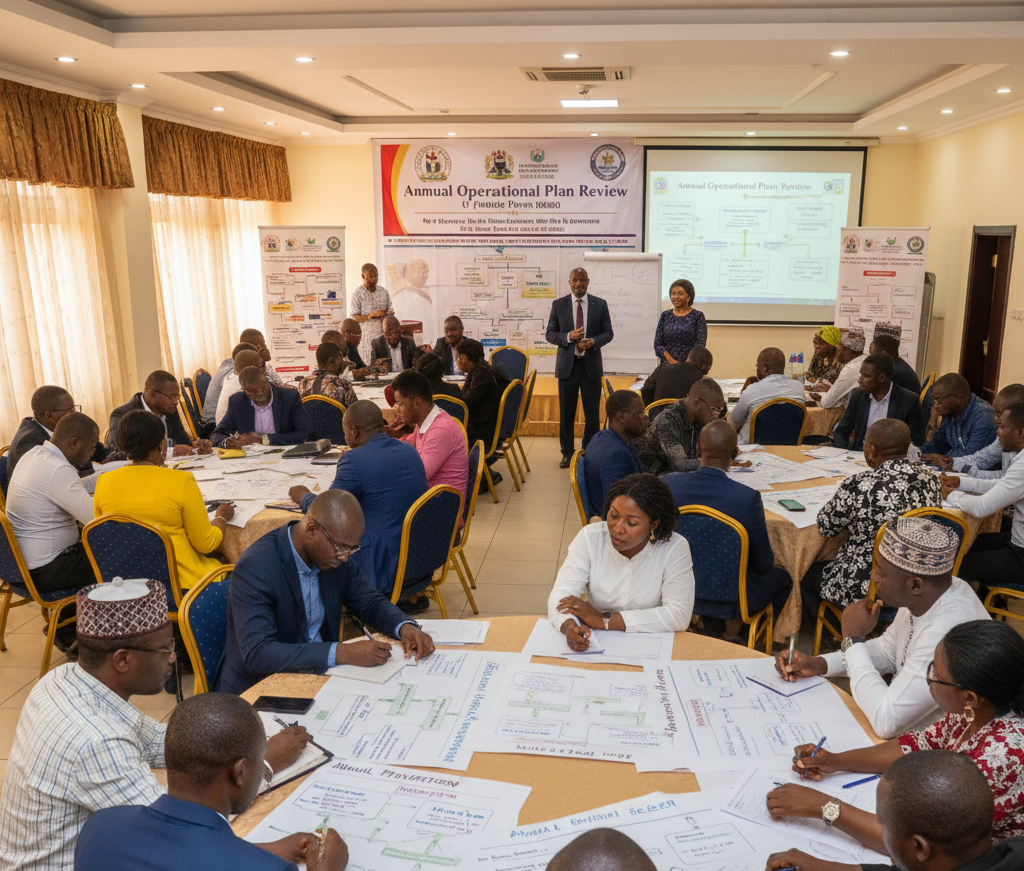
The project successfully delivered a comprehensive review of the implementation of Quarters 1–3 activities under the 2016 Malaria Annual Operational Plan and produced a fully costed, stakeholder-validated 2017 AOP for Katsina State. The process was conducted over eight days and included preparatory consultations, a five-day residential review and planning workshop, and a three-day report writing and quality assurance phase. The participatory workshop, held in November 2016, convened 50 participants drawn from the State Ministry of Health, State Malaria Elimination Programme, malaria technical working group (mTWG), and IHVN. Participants were organized into seven thematic groups corresponding to the National Malaria Programme’s objective areas: malaria prevention, diagnosis, treatment, ACSM, procurement and supply chain management, monitoring and evaluation, and programme management. Standardized review tools—including proxy indicators, performance measurement frameworks, and force field/causal analysis—were applied to assess implementation performance, identify facilitators and inhibitors, and extract lessons learned. For the 2017 AOP development, groups conducted updated situation analyses, defined SMART objectives and targets, and developed detailed activity frameworks outlining tasks, timelines, responsible actors, costs, funding sources, and output indicators. Plenary discussions enabled consensus-building on cross-cutting issues, resource mobilization strategies, and implementation modalities. The draft 2017 AOP was reviewed and validated by the mTWG before undergoing final quality assurance and submission to IHVN and the Global Fund. Overall, the exercise resulted in a state-driven, evidence-based malaria operational plan that strengthened planning discipline, enhanced partner coordination, and positioned Katsina State to implement prioritized, well-costed malaria elimination interventions in alignment with national objectives.